“Mama, watch me!”
The phrase vocative, imperative, he has not yet
learned to finesse the words, new as they are
in a brain whose age is counted in months,
not years.
So I stop, pause the endless routine,
the cross currents of treasure every moment/it goes
so fast and I only have 30 minutes to change the laundry/get lunch
ready/his brother is calling from the other room.
I watch as he stands in front of the couch, belly in line
with the cushions, trying to get his little body from floor to seat.
He is determined, forehead creased, the backs of his rounded,
dimpled little hands clenching the fabric as he tries to pull himself
up.
Eventually, he flings one leg up and straightens bent elbows for leverage that pushes
the rest of his body up, and he buries
himself between the back cushions, hiding.
“You did it!” I declare back. As the words leave my mouth, he is
moving again, putting his new skill to use, perching himself on the back
of the couch.
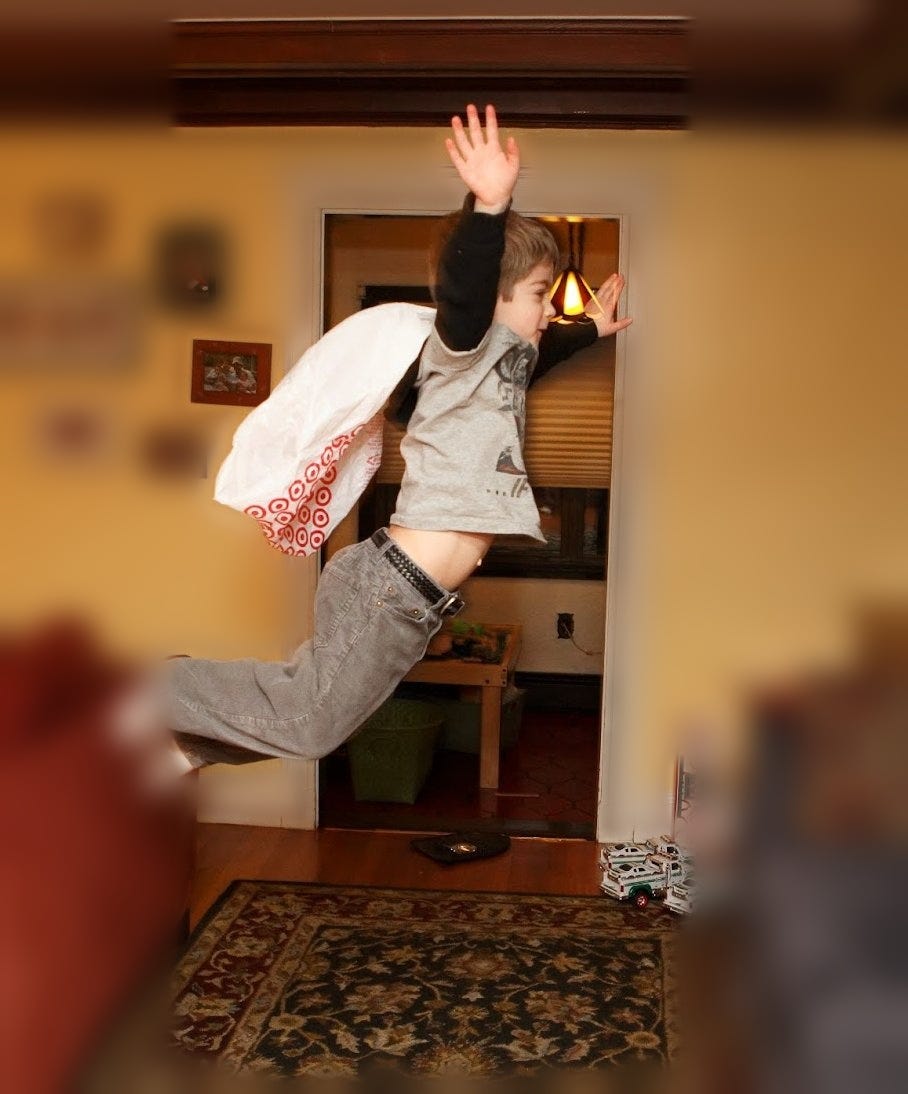
He spreads his arms, full wingspan, and says:
“I fly!”
Before I can worry, rush to stop him, I hear
a giggle, a soft landing, no thud. He pops up,
eyes barely visible above the couch back,
“You see me, Mama?” the accomplishment, with a side of mischief, flavoring those words.
“I see you, my love.”

He will fly from rocks, fallen tree branches, piles of leaves, and the stone wall in
our garden.
I worry he will launch off one of the thirty steps that lead
to our front door, a fall much greater than any he has attempted.
But he knows those limits and never tries.

His injuries—so many more than his brothers will collect—come
from much more ordinary
things: roller skating, dirt biking, burns from the wrestling mat,
a broken heart.

He catapults onto a field, chasing a ball with 17 other kids.
He runs, he kicks, he maneuvers.
I watch; those once small, chunky legs now lean and strong,
skirting around opponents, keeping
the ball between his feet, moving with him.
And then one day, he just keeps running, leaving
the ball on the field behind.

He throws himself onto a firm, tacky mat. Anxiety written
in the jaw clench,
his muscles tense, their ropey strength
new and unfamiliar. He grabs his opponent’s legs
drags him down to the hot, sticky mat and
limits his ability to move. And suddenly, it is
my boy who is on his stomach, arms held behind his back,
overpowered.
The coach clips his wings.

He propels onto a stage. He finds that he can become
other people–a chimney sweep in 1920s London, a street rat in Akrabah, a lion
in the Central Park Zoo, a prince
in a fairy tale, a greaser in 1950s America. A tortured
officer during the French student revolution.
He can make people cry with his voice, laugh
with his delivery, feel
with his presence.
He soars.

He sails off into the woods. At first, with friends, after dark, away
from constant observation, rules, and expectations.
The heartfelt conversations, laughing
until your belly aches, tears running down your face. Connection.
And then, alone, contemplating, forming what he believes, who he
is, what he wants
from this one life.

Mama, watch me!

And I watch, even when I want to close my eyes to the way his opponent has twisted his arm behind his back, caused his nose to bleed and bleed and bleed.

I watch, when his voices carries these words, so tenderly, so fully:
Stars in your multitudes
Scarce to be counted
Filling the darkness
With order and light.
I marvel at the beauty, the power, the joy
of his song, his expression, his being.

And sometimes, the imperative shrouds the plea:
Don’t look at me!
(Please see me.
I may need you.
I might even be scared.)

And so I watch, but from a distance.
I know where you are, I know
what you are doing. I am
here.
Always here.
Photo were taken by the exceptional Dana Giuliana, unless otherwise noted.
All mistakes are mine and your confirmation that the words came from my brain, not AI.


This is so powerful. Thank you for sharing. It touches memories in my heart.